Revive Hub: Modernising Supported Housing Operations with Odoo 19
Intro: Revive Hub: Modernising Supported Housing Operations with Odoo 19
Revive Hub operates in the supported housing sector, where coordinating accommodation, resident-related processes, property administration and operational activities requires reliable information and clear workflows.
Supported housing organisations often need to balance day-to-day service delivery with financial oversight, property coordination, administrative requirements and effective communication between teams.
As these responsibilities grow, disconnected spreadsheets and separate applications can make operations more difficult to manage.
The Revive Hub case study focuses on the role of Odoo 19 in building a more connected environment for supported housing operations.
For Bay Forward, the central ERP objective is to align technology with practical operational requirements, helping organisations establish structured workflows, accessible information and more consistent reporting.
Client Snapshot
The Business Challenges
1. Fragmented Operational Information
Supported housing providers manage information across properties, accommodation arrangements, residents, staff and financial processes.
When information is distributed across different systems, teams can struggle to maintain a consistent operational overview.
2. Property and Accommodation Administration
Managing multiple properties requires visibility into accommodation availability, occupancy, property records and ongoing administrative activities.
Without a structured system, routine updates and reporting can become time-consuming.
3. Financial and Administrative Workflows
Supported housing organisations need reliable processes for invoices, expenses, supplier payments and financial reporting.
Manual data entry can increase administrative workloads and create inconsistencies between operational and financial records.
4. Communication Between Teams
Housing coordinators, administrators, finance teams and operational staff may need access to different aspects of the same information.
A disconnected environment can lead to duplicated work and delayed updates.
5. Management Reporting
Leadership teams need a clear understanding of property operations, administrative performance and financial information.
When reports depend on manual consolidation, obtaining timely insights becomes more difficult.
Modules Implemented
Our Transformation Journey
1. Centralised Property Information
A structured Odoo environment can bring property-related information into a more accessible system.
Relevant capabilities:
- Property and accommodation records
- Location-based information
- Occupancy and availability tracking
- Administrative task assignments
- Property-related documentation
Any resident-level functionality would require appropriate privacy safeguards and confirmation of the project’s actual scope.
2. Operational Workflow Management
Odoo’s project, activity and workflow features can help organisations organise recurring administrative responsibilities.
Potential applications:
- Task allocation
- Follow-up reminders
- Workflow status tracking
- Internal coordination
- Escalation of outstanding administrative tasks
This can improve accountability while reducing reliance on informal updates.
3. Accounting and Financial Administration
Odoo Accounting can connect financial transactions with broader administrative processes.
Relevant functionality:
- Customer and supplier invoicing
- Expense management
- Accounts payable and receivable
- Payment tracking
- Financial reporting
- Cost allocation where configured
The exact accounting configuration depends on the organisation’s legal structure, reporting obligations and operating model.
4. Document and Information Management
Supported housing organisations handle various administrative documents.
Odoo Documents and related applications can provide a more structured way to organise approved business records.
Potential capabilities:
- Centralised document organisation
- Defined access permissions
- Document review workflows
- Record categorisation
- Controlled information sharing
Sensitive resident or care information requires additional consideration of confidentiality, GDPR obligations and access controls.
5. Reporting and Operational Visibility
Odoo reporting tools can help management monitor approved operational and financial indicators.
Examples include:
- Accommodation availability
- Administrative task completion
- Property-related expenses
- Supplier payments
- Financial performance by location
- Outstanding operational activities
These are potential reporting applications, not confirmed delivered dashboards for Revive Hub.
Discovery & Analysis
- We started by understanding how Revive Hub actually operated. Discovery and alignment sessions brought together managers, support workers, finance, and compliance leads to map the full supported-housing lifecycle.
- This covered referral and intake through support planning, risk assessment, weekly charges, compliance, and move-out, aligning each stage with Odoo 19 capabilities.
Solution Architecture & Security Design
- With the workflow mapped, we designed a multi-domain data model covering Property, Tenants, Support Plans, Risk, Finance, Compliance, Documents, Interactions, Tasks, and Move-Out.
- A five-role security model, Admin, Property Manager, Support Worker, Staff, and Maintenance, was also defined with record-level isolation, ensuring support workers could see only their assigned tenants.
Configuration & Custom Development
- The paper-and-spreadsheet process was then replaced with a single audited workflow through a custom property_management module on Odoo 19.
- The solution included a 5-step tenant intake wizard, 5-pillar support planning, 11-domain risk assessment, automated weekly service charges, and compliance monitoring.
- It also featured Odoo Sign and WhatsApp integrations, along with 6 QWeb PDF reports.
Data Migration & Integration
- Existing property, room, and tenant records were migrated from spreadsheets into structured Odoo records.
- Odoo Sign was integrated for digital signing, while the Odoo WhatsApp module enabled receipts and document links to be shared directly.
Testing & Training
- Once the system was configured, role-based training was delivered for managers, support workers, staff, and maintenance operatives.
- User Acceptance Testing covered the complete lifecycle: intake, support plans, risk assessments, service charge payments, compliance alerts, and move-outs.
Go-Live & Hypercare
- The final step was the cut-over to the new system, followed by post-go-live Hypercare to stabilise operations.
- This included resolving user queries and fine-tuning the configuration based on real-world use.
Why Odoo 19 for Supported Housing?
Odoo 19 offers an integrated ERP environment with applications for accounting, contacts, projects, documents, purchasing, reporting and workflow management.
Depending on an organisation’s requirements, these applications can be configured to support administrative and operational activities in the supported housing sector.
Potential capabilities include:
- Centralised property and accommodation records
- Structured administrative workflows
- Financial management and accounting
- Supplier and purchasing processes
- Task and activity management
- Document organisation
- Management dashboards
- Role-based access to information
The objective is not to replace the human element of supported housing. It is to reduce administrative friction so teams can focus on delivering services.
Key Implementation Considerations
- Odoo 19 ERP Architecture: Aligning applications with supported housing workflows.
- Property Administration: Structuring accommodation and location records.
- Workflow Automation: Reducing repetitive administrative tasks.
- Financial Integration: Connecting accounting and operational information.
- Document Management: Organising records with appropriate permissions.
- Role-Based Access: Controlling visibility according to responsibilities.
- Management Reporting: Building dashboards around useful operational indicators.
- Scalability: Supporting additional locations and changing requirements.
Expected Operational Benefits
More Consistent Information: Centralised systems can reduce discrepancies between departments and administrative processes.
Less Repetitive Administration: Structured workflows can reduce manual follow-ups and duplicated data entry.
Better Coordination: Teams can work from clearer task assignments and shared operational information.
Improved Financial Visibility: Integrated accounting can make it easier to review costs, payments and reporting.
A Foundation for Growth: A configurable ERP platform can support additional properties, users and operational requirements.
These are expected benefits of the proposed approach, not verified performance results from Revive Hub.
Key Implementation Highlights
1. End-to-End Tenant Lifecycle with Structured 5-Step Intake
Bay Forward built a complete tenant lifecycle, from referral through Draft, Submitted, Move-In, and Move-Out, anchored by a structured five-step intake wizard. The wizard captures personal and identity details with validated NI number and email formats, referral information, equality-monitoring data held as GDPR-optional fields, a full financial and benefits assessment, and document upload with signature collection. Validation at each transition ensures complete, consistent records, while custom mobile optimisation keeps the form usable on small screens for staff working in the field.

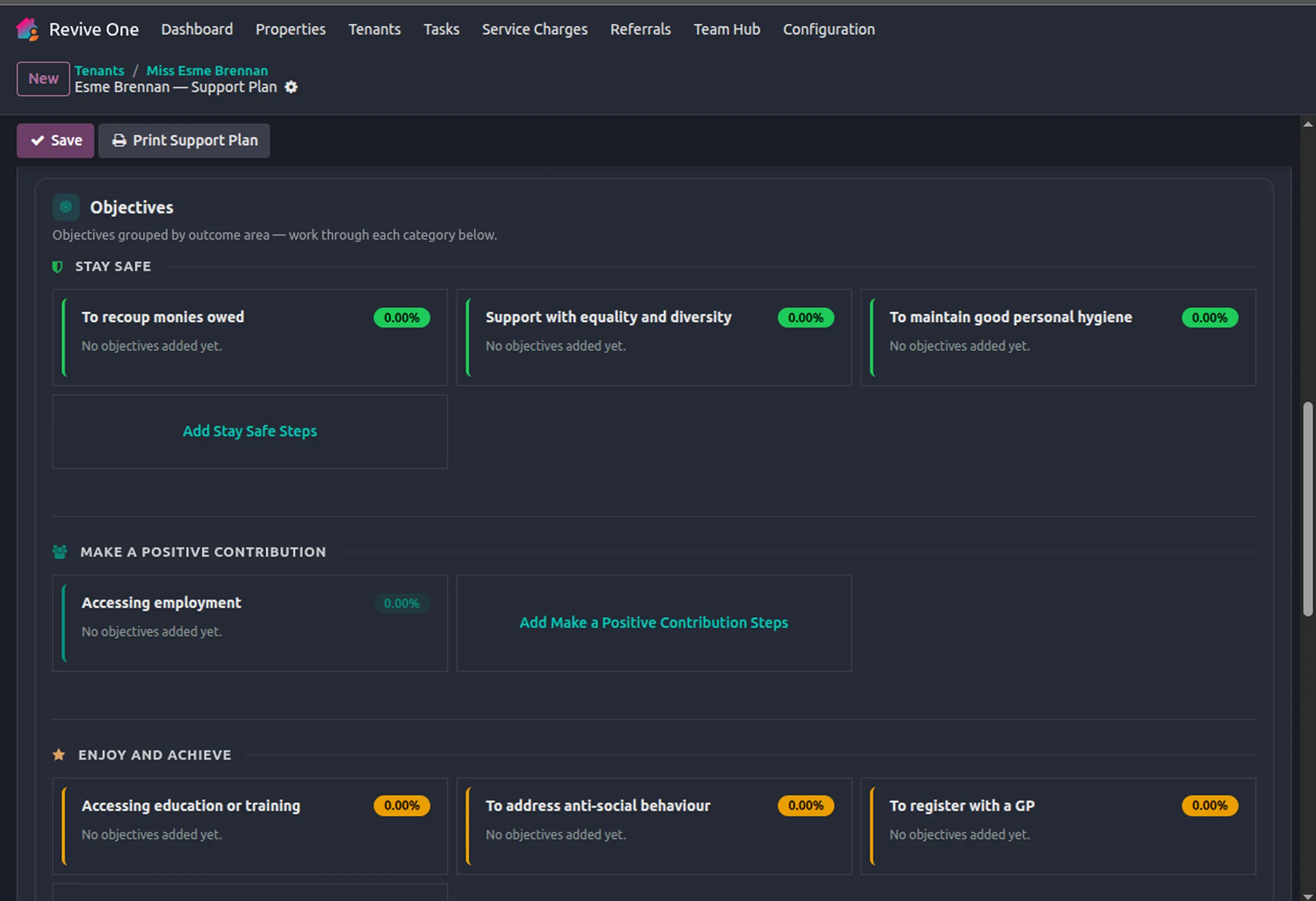
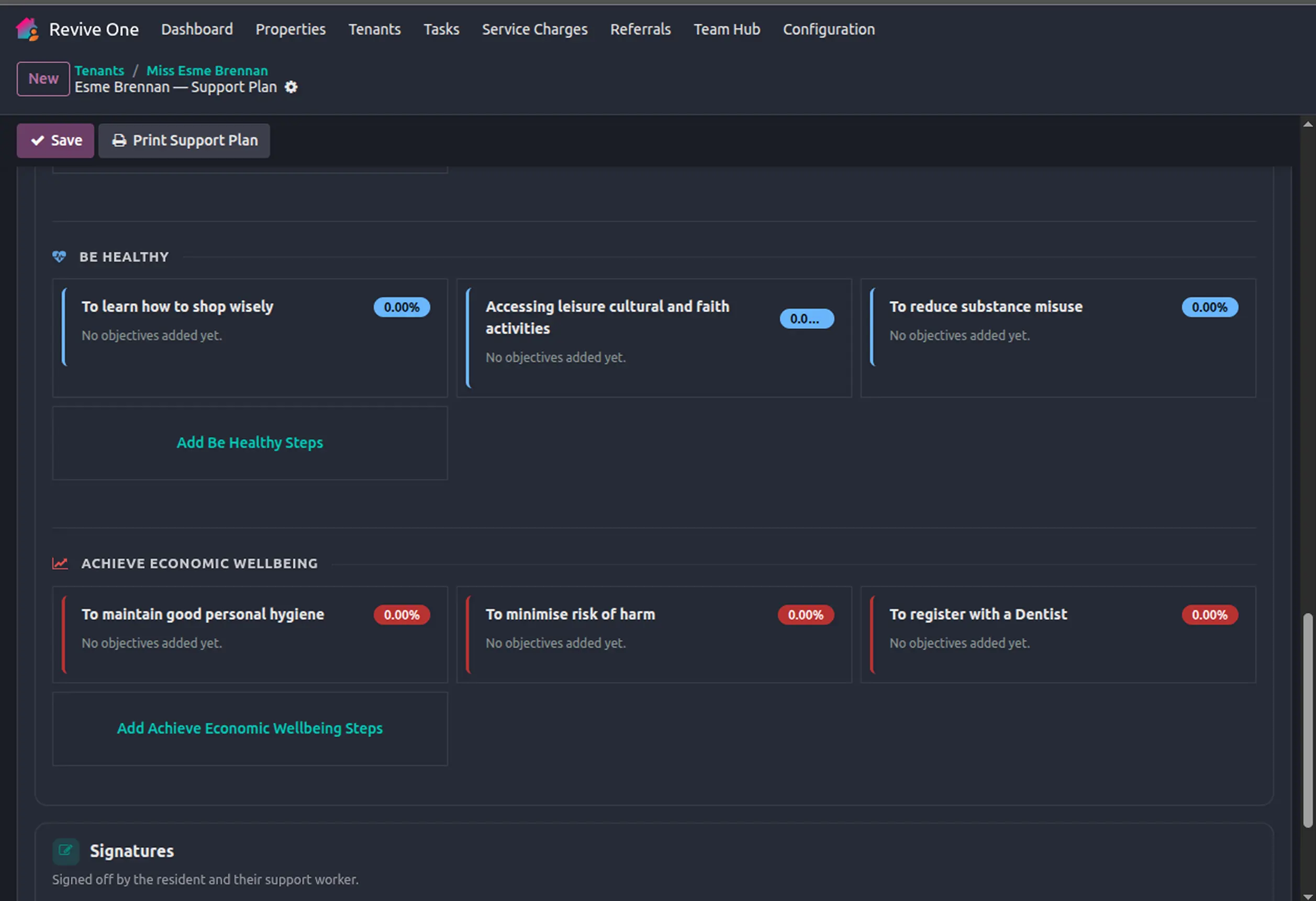
2. Five-Pillar Support Planning with Real-Time Progress
With the tenant journey structured, Bay Forward introduced support plans built around five statutory life pillars, Stay Safe, Be Healthy, Enjoy & Achieve, Positive Contribution, and Economic Wellbeing. Objectives are tracked at objective, step, category, and overall level, with progress computed automatically and surfaced on the tenant dashboard. Configurable plan templates pre-populate default objectives to reduce data entry and ensure consistency, while dual signatures from the tenant and support worker are captured directly in the form for printable, statutory-ready plans.
3. Eleven-Domain Risk Assessment with a Safety-First Approach
To strengthen safeguarding, each tenant can hold multiple risk assessments across 11 independent domains, including offending history, violence, mental health, self-harm, addictions, and finances. The overall risk level is computed conservatively as the highest level across all domains, so any single high-risk rating escalates the overall assessment. The landscape PDF output is formatted for CQC inspections and multi-agency safeguarding meetings.
4. Automated Weekly Service Charges & Payment Reconciliation
Bay Forward automated one of the most repetitive financial processes. A scheduled cron generates weekly service charges every Monday for all active tenants, with built-in duplicate prevention that makes the job safe to re-run. A payment wizard handles real-world scenarios, FIFO allocation against the oldest unpaid charges, overpayment and pre-payment handling, and carried-forward credit balances, and produces a PDF receipt that can be sent straight to the tenant by WhatsApp.
5. Compliance Certificate Monitoring with Automated Alerts
To replace manual compliance tracking, the system automatically generates 13 compliance document slots when a property is created, covering Gas Safety, EPC, Fire Risk, EICR, Legionella, and more. An expiry-urgency engine flags certificates as OK, Warning, or Danger, while an automated cron notifies the responsible property managers before deadlines pass, closing the gap that previously risked lapsed certificates and regulatory breaches.
6. Digital Signing & WhatsApp Communication
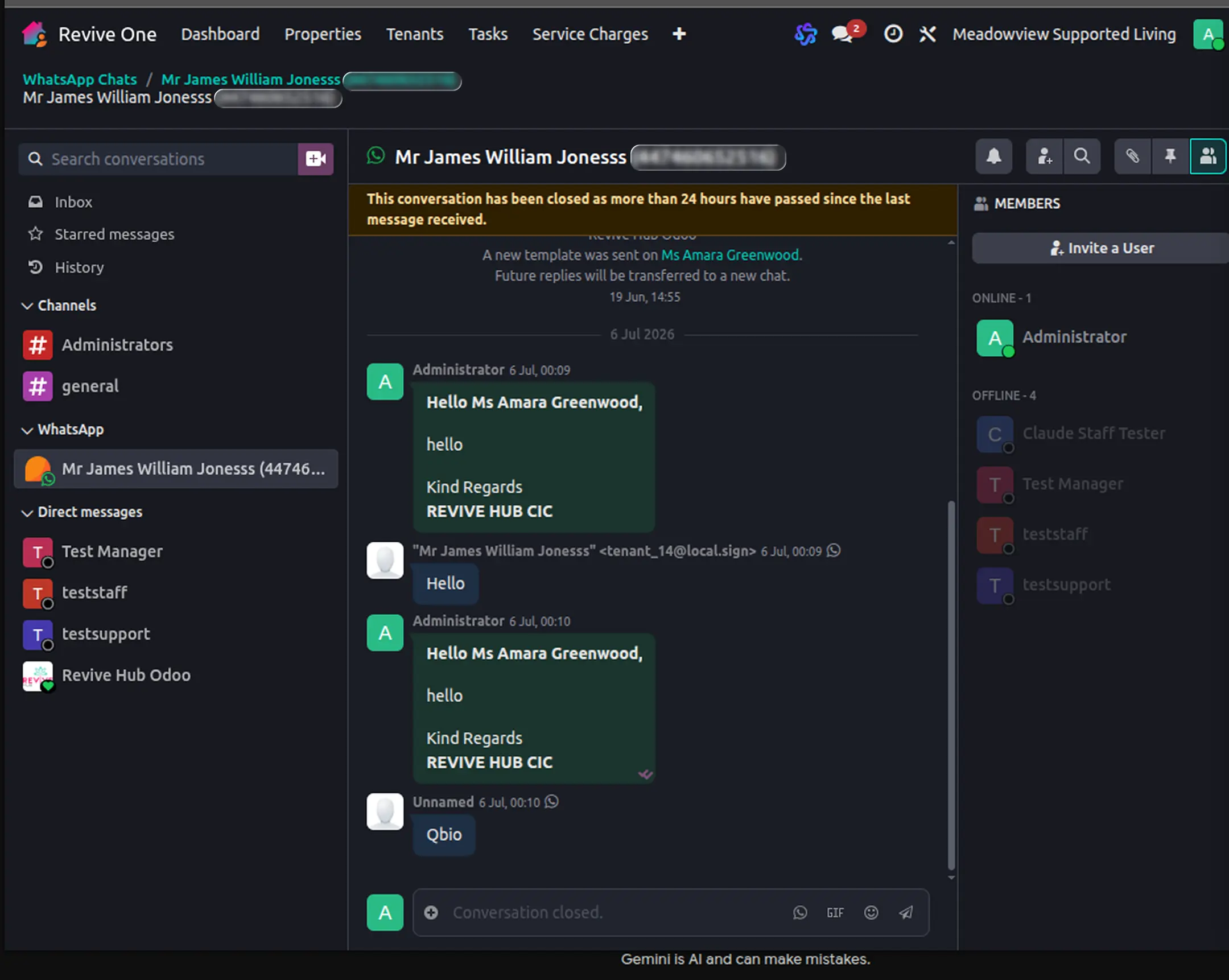
Finally, Bay Forward connected signing and communication directly to the tenant workflow. A custom Odoo Sign wrapper provides embedded, in-form signing so tenants can sign without navigating away, with default sign emails suppressed during intake to avoid confusing notifications. WhatsApp integration delivers payment receipts, signing links, and general communications, with every message logged to the tenant chatter for a complete audit trail.
Relevance for Supported Housing Organisations in Belgium
Belgian organisations operating in supported accommodation, social housing and related services may face similar administrative challenges.
An Odoo implementation can be adapted to local operational requirements, subject to a detailed assessment.
Important considerations include:
- Belgian accounting and VAT requirements where applicable
- Peppol electronic invoicing obligations
- GDPR and the protection of personal information
- Access controls for sensitive records
- Reporting requirements for the relevant organisation
- Multilingual operations in Dutch and French
- Integration with existing business applications
Belgian housing and care regulations vary by region and activity. Any implementation should be assessed against the organisation’s actual obligations.
Why Choose Bay Forward for Odoo 19 Implementation?
Bay Forward helps organisations connect ERP applications, accounting workflows and operational processes.
Our approach focuses on understanding how teams work, identifying opportunities for improvement and configuring Odoo around practical business requirements.
For supported housing organisations, this means considering property administration, financial oversight, document processes and reporting within one coordinated ERP strategy.
Explore our Odoo implementation services and Odoo accounting solutions.
Custom Developments
Client Testimonial
Why Odoo 19 for Supported Housing?
Result & Impact
Following go-live, Revive Hub replaced a patchwork of paper forms and spreadsheets with a single, audited digital workflow across its supported homes. The most meaningful outcomes were:
-
Care > admin — less paperwork means more time spent with residents.
-
Scalable foundation — new properties and homes added with minimal effort.
Planning an Odoo Implementation for Your Housing Organisation?
Discover how Bay Forward can help assess your operational workflows and design an Odoo ERP solution aligned with your organisation's needs.
Conclusion
The Revive Hub case study highlights the potential of Odoo 19 as a platform for more connected supported housing administration.
By bringing property information, financial workflows, task management and reporting into a structured environment, organisations can work toward greater operational consistency.
The final project case study should document Revive Hub’s confirmed implementation scope and outcomes before publication.
Talk to Our Team
Share your email for a quick, personalized response.


